Contact Us
+66 96-551 9996
Chiang Mai PM2.5 in 2026: Plan a Healthier Home as One System
22 August 2026Chiang Mai PM2.5 in 2026: Plan a Healthier Home as One System
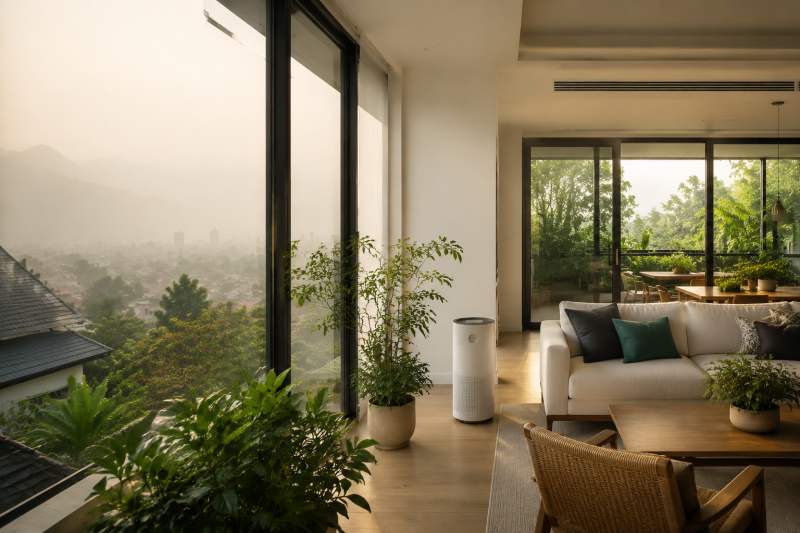
On clear days, a Northern Thai home should be able to open toward a shaded terrace and garden. During a severe haze episode, the brief reverses: how will uncontrolled air leakage be reduced, where can a vulnerable family member spend the day, and how can ventilation continue without undermining filtration? A healthy home in Chiang Mai needs both an open-air mode and a high-PM2.5 mode. That decision belongs in the architectural and building-services brief, not only in a purifier purchase after move-in.
What one 2026 episode tells homeowners
On 2 April 2026, Environmental and Pollution Control Office 1 reported 24-hour PM2.5 readings of 93.8–345.3 micrograms per cubic metre across monitoring locations in Chiang Mai, Chiang Rai, Lamphun and Mae Hong Son. The notice classified conditions as affecting health and advised avoiding outdoor activity or wearing protective masks when necessary and extra care for vulnerable groups.
These readings describe one episode across several monitoring points. They are not an annual average and do not describe indoor air in every house. They do, however, show why a Northern home needs an alternative to window-only ventilation when outdoor conditions are unsuitable.
Five layers of a workable indoor-air plan
1. Reduce uncontrolled leakage
Door and window junctions, service penetrations, ceilings and connections to garages or utility areas can admit outdoor air. A carefully detailed envelope gives cooling and filtration equipment a more predictable environment. Airtightness must still be coordinated with intentional ventilation rather than treated as a goal by itself.
2. Give the household a practical cleaner-air room
A family with an older person, child or member with an existing health condition may prioritise one bedroom or living space during severe haze. It should be appropriately sized for the equipment, easy to close, comfortable for extended use and kept clear enough to function when needed.
3. Size filtration around airflow
Real performance depends on filter type, airflow, system leakage, room volume and replacement frequency. A building-services professional should calculate the actual requirement and confirm that fans or air-conditioning equipment can accommodate the selected filter resistance.
4. Coordinate ventilation with outdoor conditions
Reducing particles should not create persistent humidity, odours or carbon-dioxide build-up. Kitchen and bathroom exhaust, the route for replacement air and seasonal controls must be considered together. The same house may operate naturally on one day and in a more controlled mode on another.
5. Design for maintenance
A filter that is difficult to reach is likely to be changed late. Equipment should have safe service access, clear filter information and a simple way to compare indoor and outdoor conditions. More devices do not automatically create a system that works in daily life.
A cross-cultural retirement-house scenario
Hypothetical example: A Thai–British couple plans a single-storey home in San Sai for themselves and an older parent. They still want large shaded openings for most of the year. Their brief could group the parent’s bedroom and a small shared living area into a controllable zone, detail opening seals carefully, place filters where they can be changed without climbing, and document when the family should switch operating modes. This is not a standard specification; equipment and details must be calculated for the actual house.
Frequently asked questions
Is one portable purifier enough?
It depends on room volume, airflow, leakage, occupancy and maintenance. Do not rely only on a marketed floor-area figure.
Must the house remain closed all year?
No. The aim is to combine natural ventilation when outdoor air is suitable with a controllable strategy during haze, while still managing moisture and fresh air.
Can a filtration system guarantee zero PM2.5 indoors?
No responsible design should promise that. Results depend on design, installation, operation, weather and filter maintenance.
When should this be planned?
During room and services planning. Equipment space, ducts, access and electrical provision are harder to add after finishes are complete.
Start with the people, not the product list
Explore our custom-home approach, review selected projects, or book a free initial architect consultation to discuss occupants, openings and service space. It excludes free drawings or house design, and indoor-air systems require project-specific professional design.
Sources
Environmental and Pollution Control Office 1 (Chiang Mai), Upper Northern Thailand air-quality notice 7/2026, 2 April 2026; Chiang Mai Province, 2026 wildfire, haze and PM2.5 response update. Accessed 22 August 2026.