Contact Us
+66 96-551 9996
Smart Home Cybersecurity Chiang Mai: Plan Security Before Devices
23 August 2026Note: The IoT draft guideline described here reflects the public consultation as of the stated date. It may have been revised or issued since; please check the NCSA website (ncsa.or.th) for the latest version before relying on it.
Smart Home Cybersecurity Chiang Mai: Plan Security Before Devices
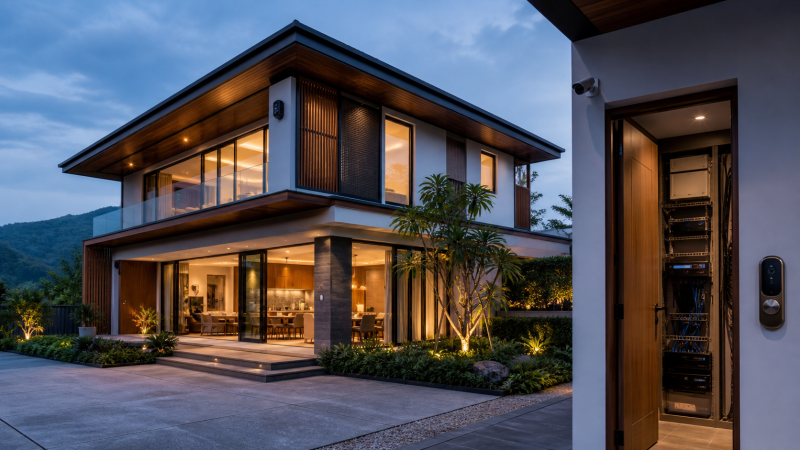
A connected home does not begin with a camera, app or Wi-Fi switch. It begins with decisions about which systems may communicate, who controls them, what continues to work when the internet is unavailable, and how the owner will maintain devices after installation. For a custom home in Chiang Mai or Lamphun, these decisions belong in the design brief alongside electrical loads, communications routes and equipment locations—not in a troubleshooting visit after handover.
Thailand’s National Cyber Security Agency invited public comments on consumer IoT cybersecurity guidance on 12 March 2026. Its stated objectives include encouraging secure devices and services, protecting personal and important user information, and supporting future standards aligned with international references such as ISO/IEC 27400, ISO/IEC 27402 and ETSI EN 303 645. The practical message for a homeowner is simple: security is not a feature attached to one device. It is an outcome created by the product, network, account setup, maintenance process and people who operate the system.
NIST expanded the same lifecycle view to connected building systems in its Cybersecurity for Building Systems project, created on 19 February 2026. The programme covers connected HVAC, security, lighting and other building services. NIST notes that building services increasingly connect to the cloud and external providers, making cybersecurity relevant from design and installation through operation, maintenance and replacement.
Replace the shopping list with an operating brief
Many smart-home projects begin with brand comparisons. That can be premature. A household may select cameras, a digital lock, air-conditioning controls, smoke sensors and irrigation from several platforms without deciding which devices need internet access, which functions must remain local, or who owns the administrator accounts. When an installer or property manager changes, access can remain active because no one has a reliable record.
A better first document is a short system operating brief. List each connected service, its importance, authorised users, the minimum offline function and the information required at handover. This gives the architect, electrical engineer, builder, network specialist and smart-home integrator a shared reference before products are purchased.
Five requirements to coordinate before construction
1. Separate networks by purpose
Consumer IoT devices do not necessarily need to share the same network as work computers or devices holding private documents. A network specialist can advise how to group equipment and where to place the router, access points, communications cabinet and spare conduit. Providing accessible routes during construction gives the owner a practical upgrade path without reopening finished walls.
2. Define account ownership and user roles
The homeowner should normally retain the main administrator account rather than relying on an installer’s personal email address. Family members, household staff, carers, rental guests and service technicians may need different permissions and expiry periods. Cameras, access control, alarms and devices that record sound or behaviour deserve particular attention.
3. Check update and end-of-support policies
In April 2026, NIST updated its foundational guidance for IoT product manufacturers to give broader attention to customer communication, maintenance, support and product end of life. Before specifying a device, ask how security updates are delivered, how long support is expected, whether vulnerability notices are published and what remains functional if the cloud service closes. A low purchase price may not represent good value if replacement requires new wiring or a new control platform.
4. Design an offline fallback
Doors, lighting, cooling and other important functions should not depend on one app or a continuous internet connection. Identify local controls, physical switches, backup access and the minimum service available during a platform outage. This is not only a cyber issue; it affects resilience, usability and occupant comfort.
5. Require a digital home systems manual
Handover information should identify device models, network zones, cable and cabinet locations, owner accounts, backup procedures, update responsibilities, service contacts and reset steps for a future owner or operator. Passwords should not be printed on drawings distributed across the project. Instead, the handover should define a separate secure method for transferring and storing credentials.
What this means for Chiang Mai and Lamphun owners
A private residence, an ageing-in-place home and a rental pool villa do not have the same risk profile. A family home may prioritise privacy and low maintenance. A villa operator needs temporary guest and staff access that can be revoked reliably. A retirement home may use sensors or alerts connected to sensitive routines. Security requirements should therefore follow the use model rather than a generic “smart home package.”
Location matters as well. A property with inconsistent connectivity or a long service journey should place greater weight on local operation, accessible equipment and clear recovery procedures. A rental project benefits from access workflows that the owner can manage without calling an installer after every guest turnover.
Where Greenery can coordinate the requirement
During briefing, the project team can distinguish building-critical functions from optional gadgets. During design development, communications cabinets, conduit, power, ventilation and maintenance access can be coordinated with the architecture. During specification, the project can define account ownership, offline operation, update information and handover documentation. Product security configuration and specialist network design should still be reviewed by suitably qualified providers for the actual project.
Explore our custom-home services, review selected Greenery projects, or contact the team to book a free initial consultation with an architect. The consultation does not include free drawings or free house design.
Frequently asked questions
Does every smart-home system need internet access?
No. Decide which functions require remote access and which should continue locally when the connection is unavailable.
Is a separate IoT Wi-Fi network enough?
It is a useful measure, but account ownership, updates, cloud access, user permissions, backups and end-of-support planning also matter.
Should we choose devices before designing the infrastructure?
Start with functions, risks and infrastructure. Then select products that fit the brief and provide credible support information.
Can an existing home improve its cybersecurity?
Yes. Begin with an inventory of devices, accounts, network access and users. Prioritise high-impact systems, then assess whether cabling or the communications cabinet needs physical improvement.
Sources
- Thailand National Cyber Security Agency (NCSA), “Public consultation on cybersecurity guidance for consumer Internet of Things devices,” published 12 March 2026 (Thai), https://www.ncsa.or.th/news/cdd7af1a366136703a000048?category=news, accessed 23 August 2026
- National Institute of Standards and Technology (NIST), “Cybersecurity for Building Systems,” created 19 February 2026, https://www.nist.gov/programs-projects/cybersecurity-building-systems, accessed 23 August 2026
- National Institute of Standards and Technology (NIST), “NIST Cybersecurity for IoT Program,” including the NIST IR 8259r1 announcement dated 20 April 2026, https://www.nist.gov/itl/applied-cybersecurity/nist-cybersecurity-iot-program, accessed 23 August 2026