Contact Us
+66 96-551 9996
Chiang Mai Heavy Rain Alert, 24–27 September 2026: Home and Site Checklist
24 September 2026Chiang Mai prepares for heavy rain, 24–27 September 2026
The Northern Meteorological Center’s warning, as reported by CM108, says parts of Northern Thailand may receive heavy to very heavy rain from 24–27 September 2026, with Chiang Mai among the provinces expected to be affected on 25 September. The warning highlights the risk of flash floods and runoff, especially near foothills, waterways and low-lying areas.
The Thai Meteorological Department’s seven-day forecast also advises people in the North and other affected regions to watch for heavy accumulated rainfall, flash floods and forest runoff. Conditions can change by district and hour, so homeowners and site teams should follow the latest official warning rather than rely only on this summary.
What the warning means for homes and construction sites
Heavy rain is not only a roof issue. Water can enter through blocked gutters, roof penetrations, poorly sealed openings, unfinished walls and low points around the site. On active construction sites, temporary electrical systems, excavations, loose materials and access routes add further risks.
Seven checks to complete before the rain intensifies
- Clear the roof-water path: remove leaves and debris from gutters, outlets, downpipes and surface drains. Confirm that discharged water moves away from the foundation and does not create a problem for neighbouring land.
- Inspect vulnerable roof details: check valleys, roof-to-wall junctions, flashings, skylights and service penetrations. A quick visual check does not replace repair by a qualified contractor.
- Protect electrical equipment: keep temporary boards, extension connections, pumps and tools above possible water levels. If water reaches electrical equipment, isolate the area and use a qualified electrician.
- Secure the site: tie down sheets and loose materials, cover cement and moisture-sensitive products, and keep drains free of sand, soil and construction waste.
- Review excavations and slopes: restrict access near saturated soil, trenches and retaining works. Cracks, movement or unexpected seepage require assessment by the responsible engineer.
- Keep an overflow route: identify where water will go if the primary drain is overwhelmed. Do not block natural flow paths without a project-specific drainage plan.
- Prepare an emergency contact chain: confirm who can stop work, isolate electricity, operate pumps and contact the local authority or emergency services.
Design lesson: manage water from roof to site
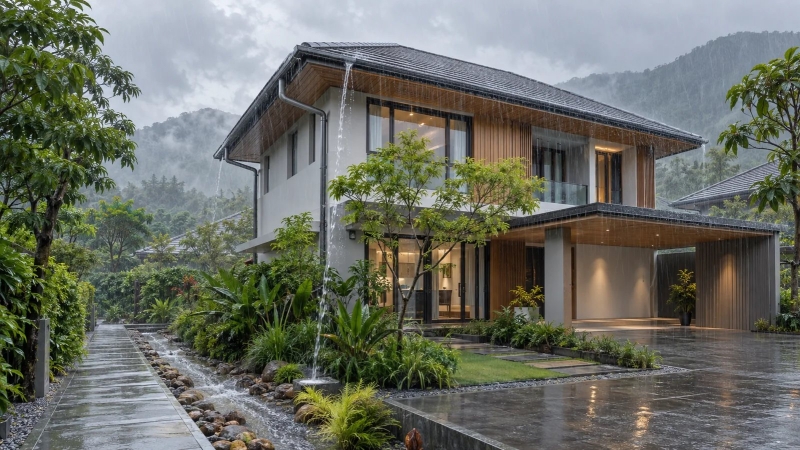
For new homes, rain resilience should be coordinated as one system: roof slope and waterproofing, gutters and downpipes, protected openings, finished-floor level, site grading, surface drains, storage or infiltration areas, and a safe overflow path. The correct solution depends on the survey, soil, surrounding levels and local drainage capacity.
The construction and design recommendations above are Greenery Design & Construction’s analysis. They are not part of the meteorological warning and do not replace project-specific advice from an architect, engineer, contractor or local authority.
Read the full guide: Designing a Chiang Mai Home for Heavy Rain: Roofs, Floor Levels and Drainage
Sources
- Thai Meteorological Department: Seven-day forecast (issued 23 September 2026; accessed 24 September 2026)
- Thai Meteorological Department: Weather warnings (accessed 24 September 2026)
- CM108: Chiang Mai prepares for heavy rain during 24–27 September (reports Northern Meteorological Center Warning No. 2 (123/2026); accessed 24 September 2026)